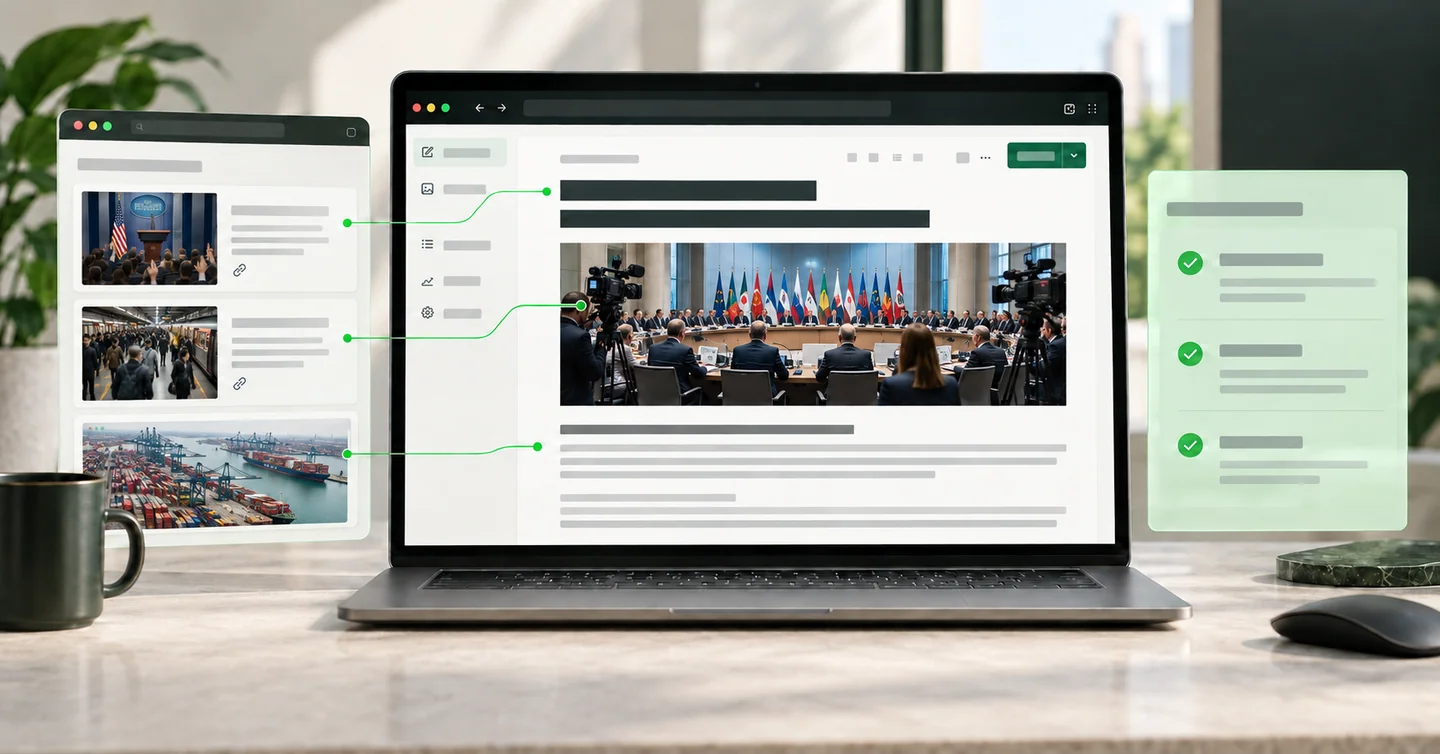
The brief goes to the writer on Monday. By Thursday, the product manager wants more technical detail, the marketing manager wants a more direct tone, and the publisher’s editor asks for anything resembling a brochure to be removed. Each is right within their own remit, and no single text can satisfy all three. In this situation the corrections point to a decision that was left open: the brief never settled the angle, and each reviewer filled the gap with their own.
The template below suits a brand preparing its first publication as well as an agency coordinating several clients. It sets out the decisions to make before writing, then the checks to carry out once the page is live. To place this framework in context, you can read our page on the sponsored article format.
What a writer needs to write well for the medium
The person writing must understand the medium’s readership as well as your offer. What they lack is your context: what the brand can demonstrate, what it must leave unsaid, what it expects of the reader once the article has been read. The brief fills that gap without dictating the sentences.
The reader and their question
Everything starts with a question phrased from the reader’s point of view. “How do we prepare a software migration without interrupting operations?” gives a text a direction, whereas “Present our solution” gives it none. Once the question is set, specify the reader’s role, sector, country and level of knowledge. A finance director discovering a topic and a technical manager comparing methods do not expect the same explanations, and a single article rarely serves both.
Then indicate where the brand fits in the answer: a method, a demonstration, data or a documented customer experience. The article holds together better when this contribution follows from the question instead of being grafted on in the last paragraph.
Evidence and its status
Each important claim calls for a usable source: dated product documentation, a transparent calculation, a study whose scope is known. A figure without an origin remains an open question, not something to publish. A quotation requires the exact words, the person’s identity and confirmation of their consent. A line suggested by a writing tool must never be attributed to anyone without that check.
Google describes helpful content as original, reliable and written by an identifiable author, in its Google Search Central guidance. That is a statement of principle, not a causal study. Our own suggestion for review preparation is a minimal register (claim, source document, date, person responsible), which lets the reviewer check a result without repeating the research.
A compact template, filled in on one case
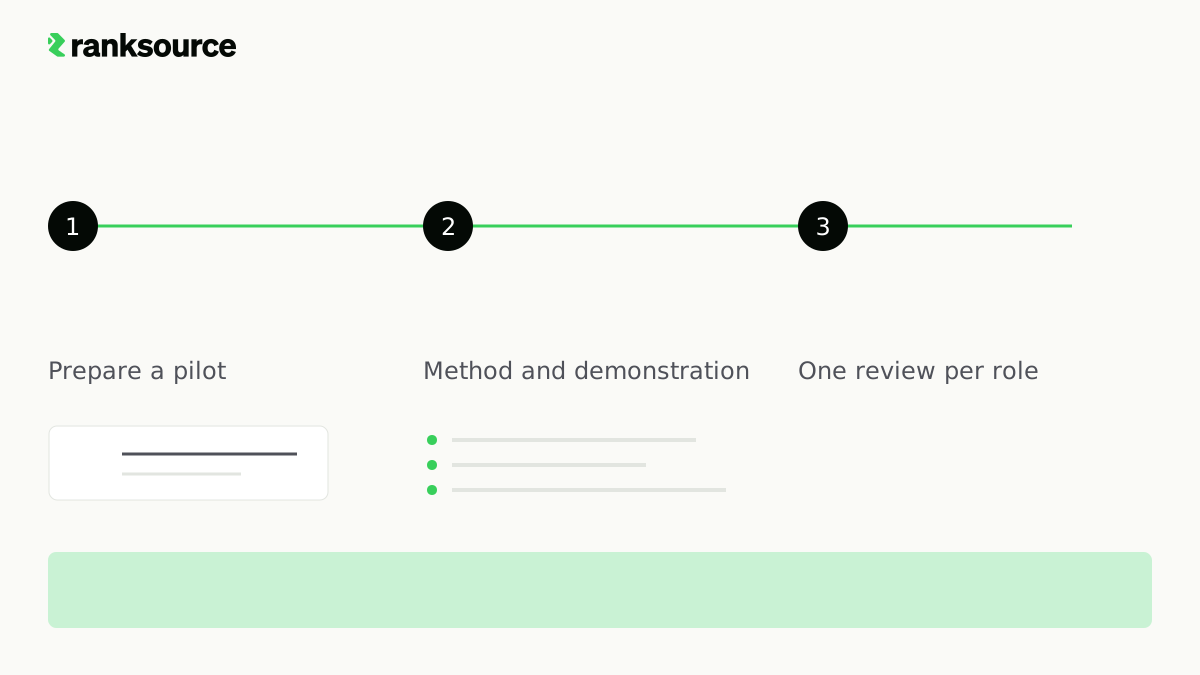
Illustrative fictional example: an imaginary company publishes a tool for managing field interventions and wants to explain how to prepare a pilot across a network of stores. Here is the template, ready to copy, with its fields completed.
- Objective: help the operations manager define the scope of a pilot before rolling the tool out.
- Reader: operations manager of a UK retail network, who knows their on-the-ground constraints but has not yet formalised the success criteria.
- Central question: what must be decided before testing an intervention management tool?
- Angle: a representative sample, a procedure for escalating incidents, criteria for stopping or continuing.
- Brand contribution: a blank preparation grid and a demonstration of the intervention journey, with no announced figures for gains.
- Evidence: documentation for the version shown, approved screenshots, a description of the journey. No customer result is available.
- Excluded points: customer results, comparisons with competitors, unpublished internal data.
- Landing page: an English-language page giving access to the grid, cited at the point where it becomes useful to the reader.
- Approval: the product manager checks the demonstration, the marketing manager the angle and the destination, the publisher the adaptation to its medium and the commercial disclosure.
Put the document version and its date at the top. When information changes, note what it replaces: a product correction slipped into a conversation disappears unless it is carried into the reference brief.
What the template settles, field by field
In the example, the evidence field is the most instructive. The company has no customer result, so the contribution field is limited to a method and a demonstration. The headline cannot promise a time saving, and the writer knows it before starting. Without that line, the question would have come back at review, from a marketing manager disappointed by a text that was too cautious.
The excluded points field does a similar job. It spares the writer from guessing what is sensitive, and the editor from spotting afterwards a mention they cannot accept. As for the landing page, specifying it avoids a default link to the home page: the reader who clicks finds the promised grid, not a journey to reconstruct.
Rewriting a vague instruction
The instructions that generate the most corrections are recognisable by their generality. “Expert but accessible tone, highlight our strengths” sounds complete and settles nothing: expert for whom, accessible to what extent, which strengths?
In the example, the usable version becomes: “The reader runs the operations of a store network and has no IT training. Use the vocabulary of their job (store, technician visit, incident), explain any software-vendor term the first time it appears, and present a single brand contribution: the pilot preparation grid.” The writer now knows what to write and the reviewer knows what to check. The instruction has become a criterion, so a disagreement about it can actually be resolved.
Dividing the reviews
Fact review
This belongs to the person who knows the product or the subject: figures, names, capabilities, examples. In the case above, it is the product manager. They also check that simplifications remain accurate. Comments on style are gathered in the editorial review, so that the writer receives one consistent direction.
Editorial review
This examines progression, clarity and fit with the readership, on the brand side and the medium side. The marketing manager checks that the angle taken is the one in the brief; the editor confirms that the text suits their audience and that its commercial nature is disclosed. The choice of medium influences all of this, and an angle is easier to adjust when you can compare media offers and their terms before writing.
Ask each reviewer to quote the passage concerned and propose a correction. “The text lacks precision” cannot be acted on, whereas “the paragraph on the pilot must say who handles incidents” states the correction expected. Before approval, also check that the headline promises what the content proves: if the documents only allow a method to be described, the headline’s promise must stop there.
Checking the page once published
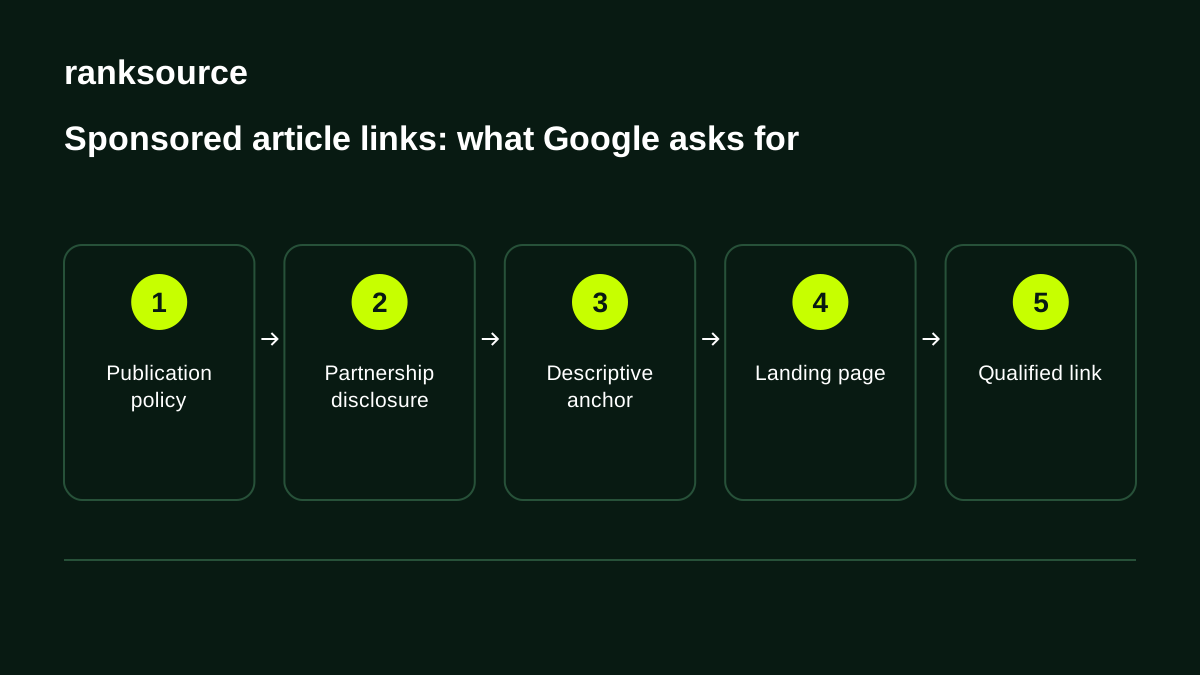
Keep in the same document the approved version, the destination URL and the list of what is verified after going live: headline, sensitive information, images and credits, commercial disclosure, links. A link placed in return for payment should be qualified as sponsored or nofollow, according to Google’s documentation on qualifying outbound links, which prefers the sponsored attribute. Our recommendation is to raise this with the publisher before delivery, and never to imply a ranking benefit in the brief or in the article.
To get started, take the list from the example, delete the fields that do not apply to your campaign and keep the excluded points line. It lets you flag the limits before the writer proposes an angle that conflicts with the information cleared for use.
To choose the medium that will host your article, you can browse the media catalogue and compare the available offers.